- Voxtral 3 connects speech and tools; a useful voice pilot needs action-level verification.
- Typed decisions offer a narrow alternative to generating prose for every classification.
- Research on AI recommendations and scientific citations challenges convenient proxy measures of quality.
Where capability meets the work.

Enterprise Ops4 min read
A typed-decision preprint explores reading a fixed set of options in one forward pass. The opportunity is narrower, cheaper decision work with explicit labels and a measured failure policy.
As a leader: Identify repeated fixed-option decisions and compare a specialized path against the current generative workflow.
As an individual: Define the option set and test ambiguous cases before optimizing the way a model returns its choice.
Read the analysis →
Models, platforms, and the choices they create.
Vendors4 min read
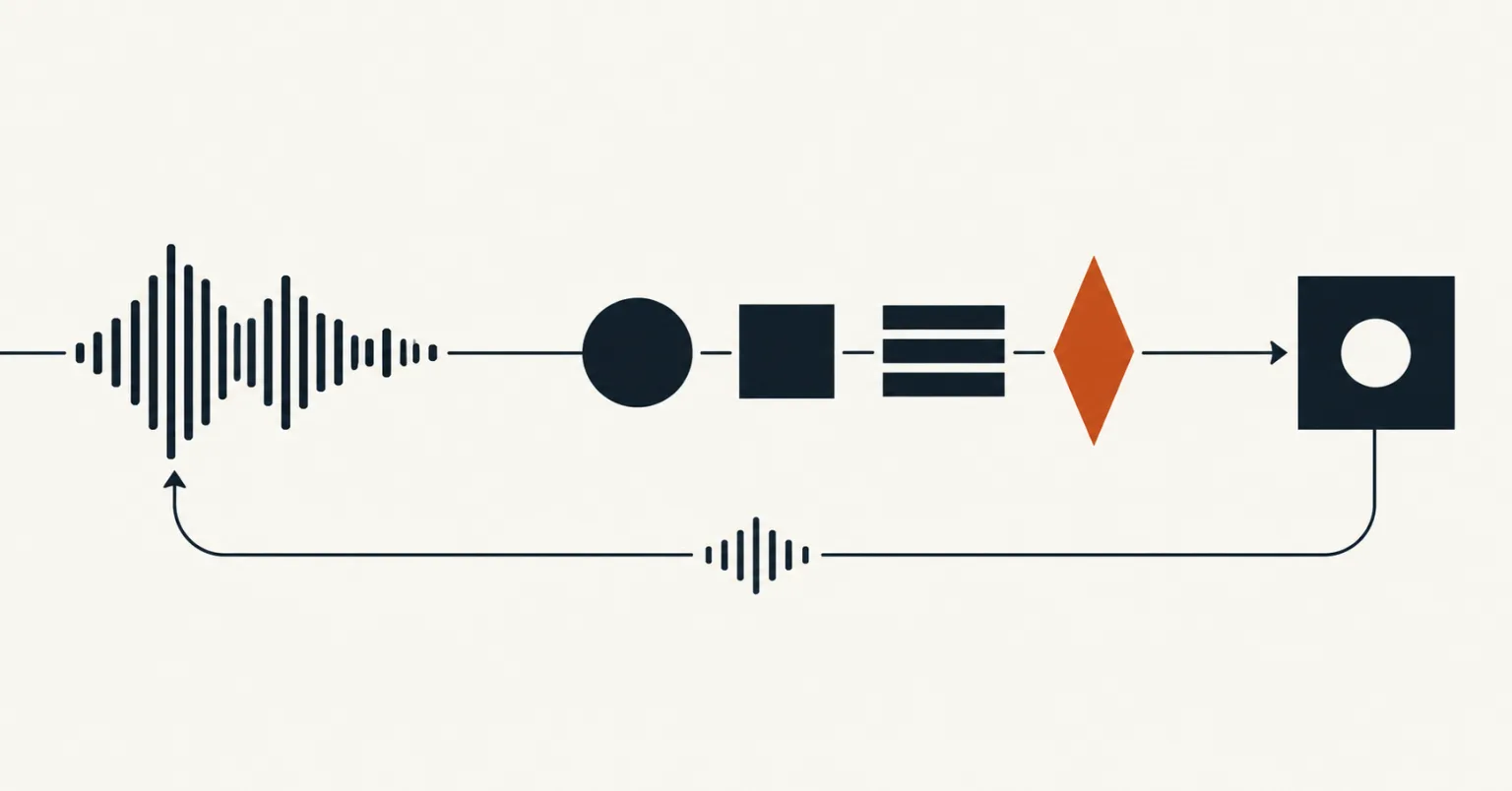
Mistral’s Voxtral 3 combines speech models and a voice-agent SDK. The operating challenge is preserving intent, corrections, and authorization as a conversation becomes a business action.
As a leader: Evaluate voice agents on correctly completed and authorized actions, including interruptions and corrections.
As an individual: Test whether a corrected reference number reaches the tool call and the final confirmation consistently.
The boundaries that need to hold.

Security4 min read
A biomedical claim-verification study finds that valid publication identifiers can hide irrelevant evidence. Enterprise retrieval systems should test the relationship between a claim and its source, beyond link existence.
As a leader: Require evidence of claim-to-source relevance in retrieval evaluations, alongside checks that citations resolve.
As an individual: Open the cited material and verify the specific claim and context before treating the link as support.
Rules, accountability, and public decisions.

Policy4 min read
Research traces how training and question wording affect AI-related recommendations. Mentioning AI more often does not prove better or worse advice; it does make evaluation of the recommendation process important.
As a leader: Evaluate proposals against a problem-specific rubric that does not reward AI merely for being present.
As an individual: Ask for assumptions, evidence, and viable alternatives before adopting a model’s preferred approach.
- OmniSimulator: Aligning Small Language Models for Authentic Heterogeneous Behavior Modeling ↗
Researchers propose OmniSimulator, a training framework that enhances small language models' ability to simulate authentic user behavior by organizing reasoning into a five-dimensional schema and using high-quality data from real user interactions. The approach employs a teacher model to generate detailed reasoning traces, helping smaller models learn meaningful behavior patterns rather than superficial correlations. Using nearly 10,000 training instances from three months of data on 200 users, OmniSimulator improved the Qwen3-8B model's performance by over 34%, achieving results comparable to larger models like Claude-Sonnet-4.5 while enabling smaller-scale, self-hosted deployment. These findings suggest that structured behavior-oriented reasoning can enable scalable, high-fidelity user simulation with smaller language models.
- Mitigating Query Shortcuts in Chain-of-Thought with Context-Aware Decoding ↗
arXiv:2610.29518v1 Announce Type: cross Abstract: While Chain-of-Thought (CoT) prompting improves the reasoning performance of large language models (LLMs), recent studies have shown that final answers do not always depend on the generated rationales. In particular, LLMs may rely on query-specific shortcuts rather than the information provided by their reasoning steps. In this paper, we investigate whether context-aware decoding (CAD), an existing contrastive decoding method, can mitigate such shortcut behavior when applied to CoT reasoning. We study this application as Rationale Contrastive Decoding (RCD), which contrasts the next-token distributions conditioned on the query with and without its rationale, amplifying tokens whose likelihood increases due to the rationale. We provide a theoretical interpretation of this decoding rule via a KL-regularized reward-maximization objective. Experiments across five reasoning benchmarks demonstrate that RCD improves answer accuracy over standard CoT. Furthermore, intervention analyses using ground-truth and random rationales reveal that RCD increases the behavioral dependence of final answers on the rationale content. Our findings suggest that contrastive decoding offers a simple, training-free approach to mitigating query shortcuts.
- Unintended Side Effects of Value Training in LLMs ↗
arXiv:2610.29922v1 Announce Type: cross Abstract: As LLMs are increasingly deployed in value-sensitive contexts, aligning them with human values has emerged as a post-training objective in NLP, aimed at instilling additional values and guiding model behaviour. However, current evaluations remain narrow. Because values are interconnected, it is unclear how fine-tuning for specific values alters unrelated capabilities and behaviours. In this work, we adapt four instruction-tuned LLMs across individual Hofstede's value dimensions and evaluate them on both cross-value transfer and broader behaviours. We find that value-specific training produces unintended side effects on untrained values, risk preferences, social cognition, and safety traits. Consequently, we suggest that value alignment after post-training should incorporate broader behavioral evaluations, and we highlight the need to investigate where additional value training might best fit into the pipeline.
- Evaluate voice agents on correctly completed and authorized actions, including interruptions and corrections.
- Identify repeated fixed-option decisions and compare a specialized path against the current generative workflow.
- Evaluate proposals against a problem-specific rubric that does not reward AI merely for being present.
Editor’s notes and source record
Reconstructed from the feed repository at 85d42d142bb59ecbf976a83945e3dc8538440b4d. Checked 235 curated and 80 ranked entries. Full coverage uses verified original-source timestamps, not the feed’s curation date. Late-arriving, undated, inaccessible, conflicting, and overlapping stories were excluded. Related research is grouped by enterprise decision; remaining eligible research may appear as short links. Published 4 complete analyses with original generated heroes. Source facts are attributed; practical implications are editorial interpretation.
Coverage: 2026-10-21T00:00:00+00:00 → 2026-10-22T05:00:00-07:00
Historical feed snapshot ↗