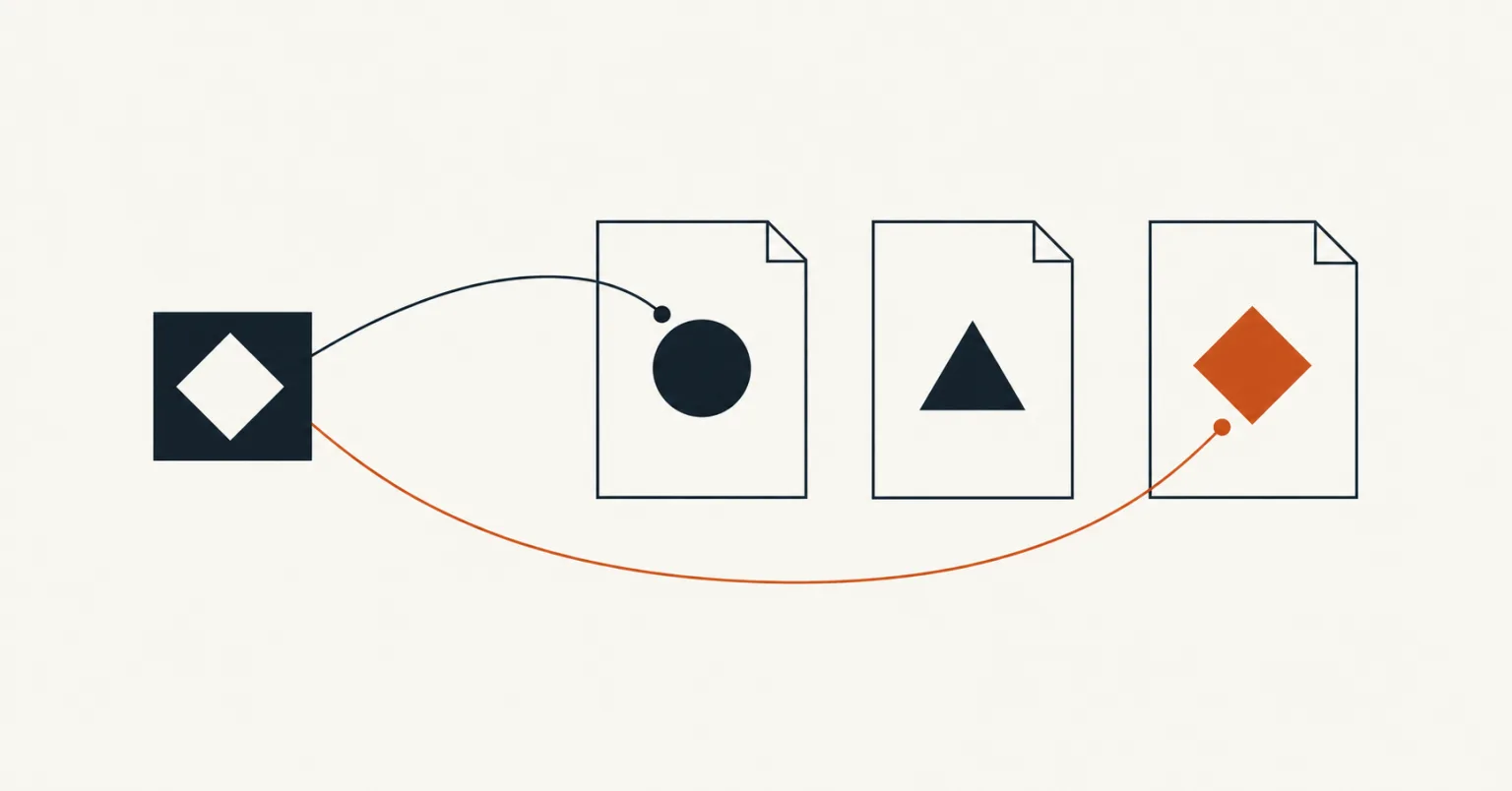
Open the reference beside a confident sentence and ask where the evidence is. The link may work perfectly. The paper may be real. You still need to find the part that supports the sentence you were asked to believe. That small step between opening a source and checking its meaning is where a citation becomes useful evidence.
A preprint on biomedical claim-verification agents studies that distinction using a controlled task and PubMed retrieval. The authors report that closed-book models often supplied identifiers for real papers while those papers rarely supported the claims being checked. Their experiments also separate retrieval limitations from the performance possible when relevant abstracts are supplied. The study is narrow and some comparisons are not statistically resolved at its sample size.
Follow the connection all the way through: a claim, a retrieved passage, and the conclusion someone draws from that passage. Each step has a job. A citation check becomes more useful when the reviewer can see whether the evidence actually carries the meaning that the answer assigns to it.
Define what the reference must establish
Before scoring a response, identify the claims that require support and the kind of evidence appropriate to each. A source can establish that a company made an announcement without independently validating the announcement’s performance claim. A policy document can describe a rule without proving that it applied to a particular historical case.
Those distinctions should be part of the evaluation rubric. Ask whether the cited material is relevant, whether it supports the strength of the statement, and whether important conditions or limitations survived the summary. A working URL is a useful preliminary check, but it cannot answer those questions.
Give the reviewer a claim and the passage meant to support it. A page full of references can leave that connection for the reader to reconstruct. Keeping the unit small makes the work more manageable: locate the evidence, read it in context, and decide whether it supports this particular statement. The bibliography can grow after those connections are clear.
Separate search from interpretation
A retrieval failure and an interpretation failure need different remedies. If the relevant evidence never reaches the model, revising the answer prompt may have limited value. If the evidence is present but the conclusion misstates it, expanding the search may add noise without addressing the error.
Use a controlled evaluation that can distinguish the two. Compare ordinary retrieval with a condition where reviewed relevant material is supplied. Inspect the returned passages, not just the query or the final answer. This makes it possible to locate a bottleneck before choosing a new model or indexing strategy.
The paper’s controlled design is useful precisely because it exposes that separation. Its numerical results should remain attached to its task, tools, and sample. An enterprise needs a corresponding evaluation on the documents and decisions its own application handles.
Preserve scope and version
Source relevance includes time and context. An accurate citation to the wrong version of a procedure can still mislead a user making a current decision. Retain the document identifier, version or retrieval date where available, and the passage used to support the claim.
When the source changes, decide which question the user is asking. Do they need the current rule, or the rule that applied at an earlier date? The newest search result may be useful for the first request and unsuitable for the second. Keep that choice visible so the reviewer can follow the answer back to the version that actually supports it.
This is particularly important for a retrospective analysis. The preparation date of an answer does not establish when the evidence became available. The evaluation should make later information visible instead of allowing it to improve an earlier decision invisibly.
Make insufficient evidence an acceptable result
Some questions will remain unresolved by the retrieved material. The application should have a supported way to say so, ask for clarification, or send the question to an accountable reviewer. A requirement to provide a definite answer to every input can encourage a polished conclusion from inadequate evidence.
Measure that behavior alongside answer accuracy. A system that properly identifies an unsupported claim is doing useful work, provided the user understands what remains unknown and how to proceed. The review should distinguish that result from a retrieval error presented as a confident answer.
Do not assume that adding more references solves the problem. Additional sources can improve coverage, but only if their relationship to the claim is examined. A longer bibliography can otherwise give the same weak inference a more impressive appearance.
Add a control case containing a genuine source that discusses the topic but does not establish the particular claim. This tests whether the review can distinguish relevance from support. A source can pass a link check and still require the answer to be narrowed or withdrawn.
Audit a small set of real answers
Choose a sample of consequential answers from an existing retrieval application. For each supported statement, ask a reviewer to open the source, locate the evidence, and judge whether the wording preserves its scope. Record link validity, relevance, and support as separate findings.
Keep the disagreements and use them to improve retrieval and response, with cases you can return to in later evaluations. This is a practical quality check for evidence handling, not a medical recommendation or a universal finding about scientific assistants. When you next open the reference beside a confident sentence, stay with it long enough to locate what the sentence is asking it to prove.