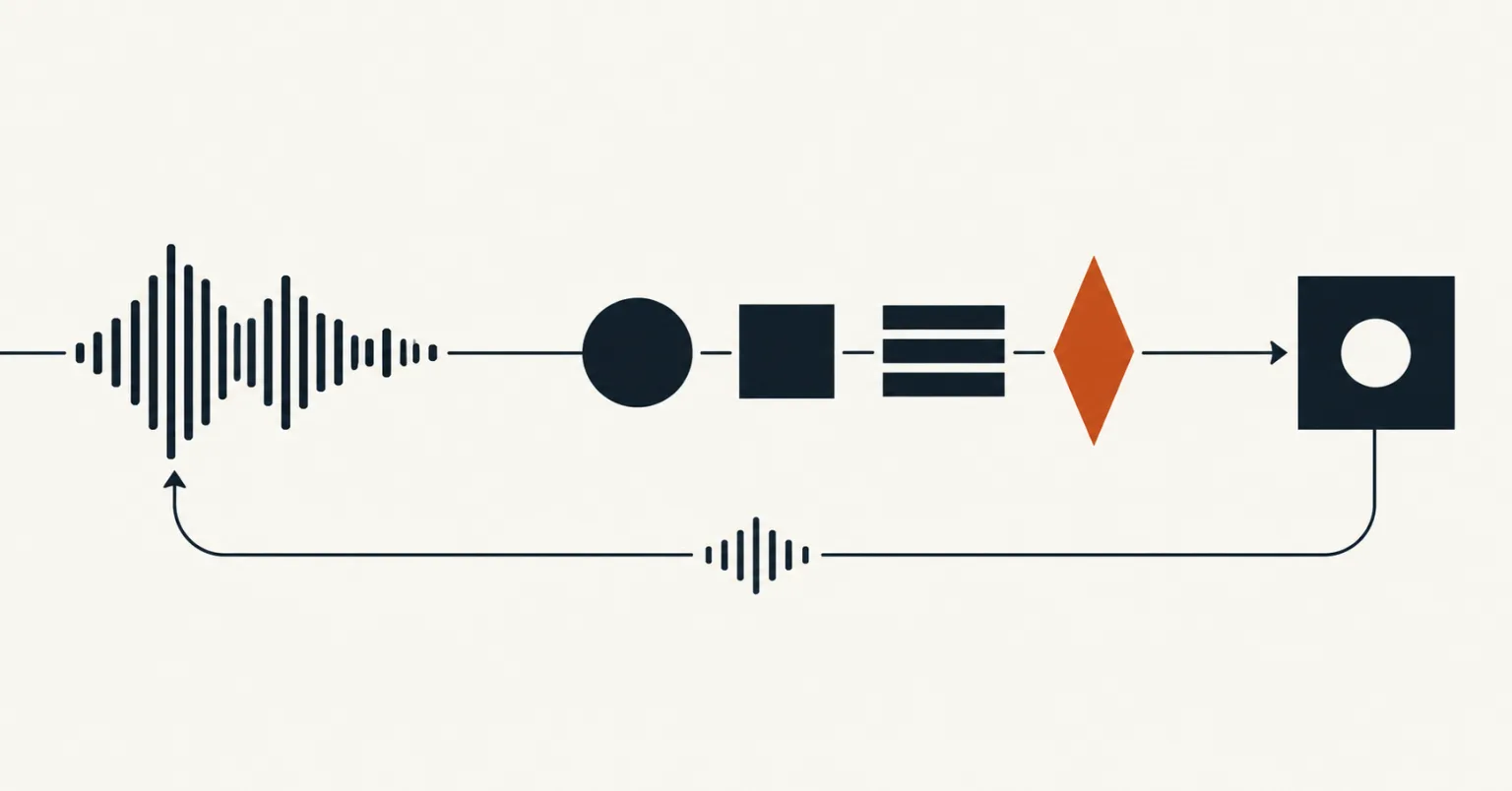
Picture a caller correcting a detail halfway through a request. The conversation can sound perfectly natural while the connected system still holds the earlier value. A voice interface has to carry the person’s current intent into an authorized action, then establish what happened. The words sounding right are part of that job. The result has to be right as well.
Mistral’s Voxtral 3 announcement introduces speech models and a voice-agent SDK connecting listening, reasoning, tool use, and speech. The company describes transcription across more than 50 languages, multilingual speech generation, and deployment through its EU-hosted API or an organization’s own infrastructure. Its performance statements are vendor claims. They make the release relevant to an evaluation, rather than establishing production readiness for every contact center or service desk.
Start the pilot with an action whose result the team already knows how to check. That gives the conversation a destination you can inspect. You can then follow what the user said, what the agent understood, and what the connected system actually did, without asking a fluent response to stand in for the whole journey.
Preserve the corrected request
Spoken requests develop over time. A person may pause, interrupt, correct a number, or revise a choice before finishing. The system needs a clear account of which version of the request is current when it prepares a tool call.
Include those interactions in the evaluation. Ask a user to correct an identifier midway through the conversation, then inspect the value passed to the connected system and the value repeated in the confirmation. A plausible spoken response is insufficient if the tool used an earlier value.
When the task fails, walk back through the conversation. Was the speaker identified, were the words transcribed, was the turn handled, and was the right action selected? Each stage contributes different evidence. Keep enough of it to find the point where meaning was lost. A final pass or fail leaves the people repairing the service with much less to work from.
Give confirmation a concrete meaning
An application should distinguish an acknowledged request from a completed action. If a voice agent says a change is complete, the organization should be able to connect that statement with a verified result from the relevant system.
For a consequential step, define what the user must confirm and which details the confirmation binds. The design should make it possible to tell whether the person accepted the actual proposed action, especially after a correction or interruption. This is an operating recommendation, not a claim about a default behavior in the Voxtral SDK.
Test uncertainty explicitly. If the spoken input is ambiguous or a tool response is incomplete, the agent should have a supported way to clarify, defer, or hand off the request. The acceptance criteria need to recognize those outcomes as appropriate when the evidence does not support action.
Evaluate the whole conversation
A language count does not establish quality on an organization’s particular vocabulary, accents, and communication conditions. Build the pilot set from representative tasks and include the names, identifiers, and specialist terms the service actually handles.
Keep results separated by the conditions that matter to the service. An aggregate score can conceal a difficult group of interactions or a particular stage where the system loses meaning. Have qualified reviewers examine those cases, and preserve the evidence needed to reproduce them.
Measure the time to a useful, correct outcome as well as the responsiveness of individual stages. Fast acknowledgment can improve the experience, but an action that requires repeated correction has a different operating cost. The evaluation should show both rather than allowing fluency to stand in for task quality.
Decide where the record belongs
Follow the conversation into the records it leaves behind: audio, transcripts, intermediate interpretations, tool calls, and confirmations of the outcome. Which does the application need, who can read them, and how long should they remain? Work through those choices individually. The deployment label alone cannot answer every question about the material people supplied while trying to get something done.
The announcement’s deployment choices are relevant because organizations may have different infrastructure and information-handling requirements. A self-deployed option still needs an operating team, capacity planning, updates, and a supported recovery path. A hosted option still needs an understood service boundary and the applicable commercial and data terms.
Bring those choices into the pilot before expanding the workload. The people responsible for investigating an incorrect action need enough evidence to reconstruct it, while the organization should avoid retaining sensitive conversation content without a defined purpose.
Include a conversation where a specialist term appears inside otherwise ordinary speech, then changes after a correction. Verify both the interpreted value and the action argument. Also test a user who moves between supported languages during the same task. Treat these as application acceptance cases; broad language coverage alone does not establish that a particular mixed-language workflow works.
Start where success is observable
Select a low-complexity workflow with a clear user, a bounded tool action, and an existing human handoff. Exercise the ordinary path, a corrected request, an interrupted confirmation, and an unavailable downstream system. Inspect the trace and the result for each case.
Keep the previous service path available and name the person who responds when the voice workflow cannot finish. Then return to the caller who corrected the request. Can the team show that the correction reached the action and its verified result? The new components become a dependable service when the people using them can follow that connection and obtain help when it breaks.