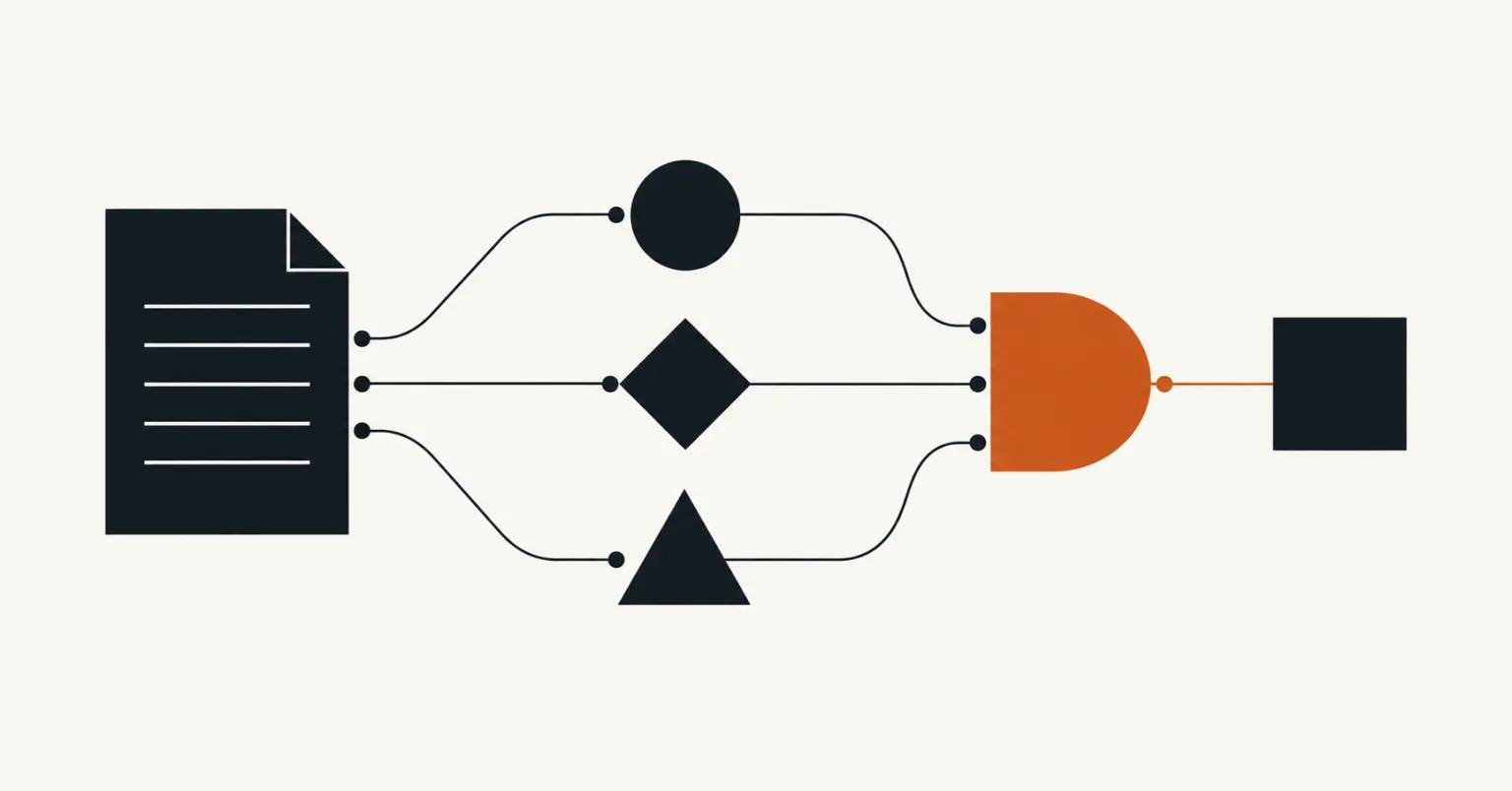
Follow the policy sounds like a short instruction. Try carrying it through a decision that depends on several conditions, evidence from different places, and an exception that applies only after a particular sequence of actions. The sentence has become a small program. Someone has to be able to inspect how that program reaches its answer.
The SCOPE preprint explores compiling such policies into programs composed of smaller neural predicates, deterministic extractors, and explicit logic. The authors optimize the program with counterexamples and report favorable accuracy and stability on their evaluated policy tasks. Those findings are research evidence for the approach, not a proof that an automatically compiled enterprise policy is correct in every situation.
Open the verdict and look for the parts that produced it. Can the policy owner recognize the conditions, can an operator find the evidence, and can a reviewer test how those parts were combined? Those questions give an inspectable policy program a job beyond producing a plausible final explanation.
Make the policy interpretation reviewable
Start with the authoritative policy and identify the decisions the application must make from it. Record the conditions, relevant exceptions, required evidence, and allowed outcomes. The person responsible for the policy should be able to recognize that interpretation before it becomes an executable gate.
A generated program is an implementation proposal. It may omit a qualification, broaden an exception, or resolve an ambiguity in a way the policy owner did not intend. Keeping the mapping between the source rule and its checks visible gives the review something more concrete than a plausible overall explanation.
Distinguish a genuine policy ambiguity from an implementation error. If reviewers disagree about the intended result, route that question to the policy owner and retain the resolution. Repeatedly adjusting the model until it gives a convenient answer would conceal the underlying governance decision.
Separate extraction from judgment
Some conditions can be checked from a well-defined field or an exact comparison. Others require interpreting language or context. A composite system should make that distinction clear because the components have different failure modes and different evidence requirements.
For example, an application might need to establish that a required identifier is present and that an action fits an approved purpose. The first question may have a straightforward data contract; the second may require a reviewed semantic judgment. This is a hypothetical design example, not a description of a particular SCOPE deployment.
Give the operator a path from the final verdict back through its intermediate results. Which condition was responsible, what evidence did it receive, and what remained uncertain? Those details make a pass or fail easier to investigate. They also give a correction somewhere specific to go, instead of requiring the team to adjust an opaque overall answer.
Test combinations and boundaries
Checking each condition independently is necessary but may not reveal a mistake in how the conditions are combined. Include examples where one condition changes while the others remain fixed, along with cases exercising exceptions and missing information.
Use reviewed expected outcomes and preserve the reasoning behind them. Counterexamples are useful when they expose a mismatch with the policy, not merely when they make a score improve. A collection of difficult cases becomes a durable asset if the organization knows why each case belongs in it.
Keep a held-out evaluation separate from the examples used to generate or repair the program. Otherwise the team may learn that the implementation fits its development cases without learning how it behaves on new inputs. Report important categories and unresolved disagreements alongside the overall result.
Preserve uncertainty through composition
A semantic predicate may be uncertain even when the code combining predicates is deterministic. The overall system needs a defined response when the evidence is incomplete, a component fails, or a judgment does not meet the application’s confidence requirement.
Ask what happens when a required check produces no usable result. Deferral, a request for more evidence, or an accountable human review may be appropriate, depending on the workflow. Have the policy owner and application owner agree on that behavior, then test it. The missing result should remain visible in the record rather than quietly turning into permission to proceed.
Also examine whether intermediate confidence values are meaningful for the decision. A number attached to a predicate is not automatically a calibrated probability. The evaluation should show how it is used and whether it helps distinguish acceptable from unacceptable cases.
Represent an unavailable check explicitly in the decision record. Record which input or component was missing and which fallback applied. This lets an operator distinguish a policy rejection from an incomplete evaluation, and it makes the next required action visible without reconstructing the entire program.
Maintain the program with the policy
A policy revision should identify which checks, examples, and operating decisions need to change. Version the policy interpretation and executable artifacts together closely enough that an incident can be traced to the rules actually in effect.
Choose a bounded compound rule with a known owner and clear expected outcomes. Compare the current implementation with parts you can inspect, including the time needed to investigate an error and revise the rule. Then ask the owner to follow a verdict back to the policy. A useful implementation lets that person recognize the rule, understand the decision, and keep the uncertainty in view when the policy changes.