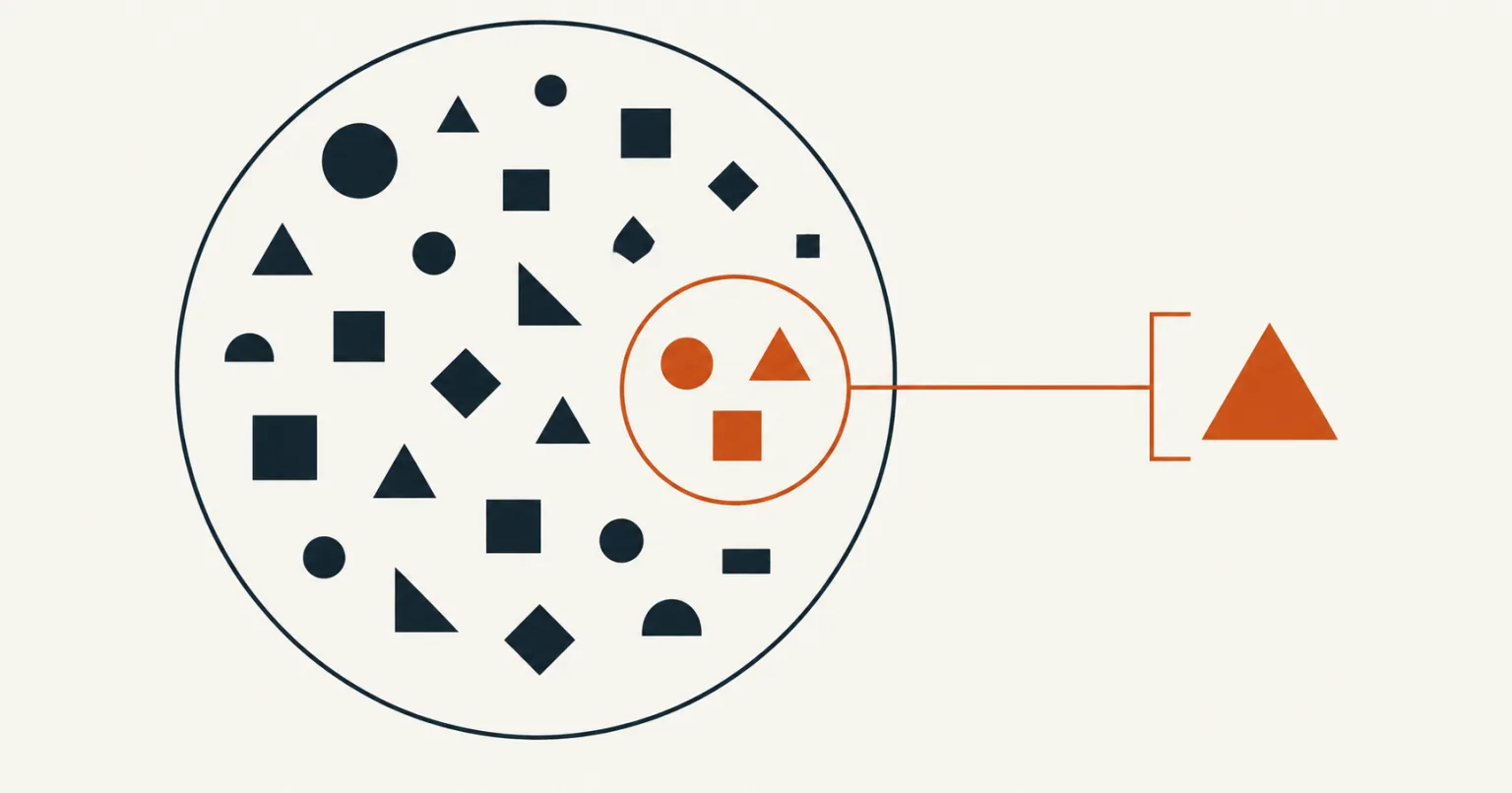
When somebody says people are using AI, what work do they mean? They might mean access to a chatbot, an occasional conversation, or reliance on it for a particular task. Each tells you something different. An adoption statistic becomes useful for a decision when you can connect its percentage to the activity that was actually measured.
Pew Research Center’s October 23 report makes that distinction visible. In its survey of 5,273 U.S. adults, 8% say they are using AI chatbots for information related to the 2026 elections. The report contrasts that figure with much broader general chatbot use. This is a U.S. public-opinion study about a specific information task, not a measure of enterprise adoption or a finding about the quality of chatbot answers.
Before carrying the number into another discussion, name the task and the people the percentage describes. That denominator gives the observation its scope. You can then ask what the result helps establish, and what additional evidence would be needed before using it to decide something about a different group or kind of work.
Name the behavior the organization needs
An enterprise may count provisioned accounts, active users, requests, repeated use, or completed work. Each measurement can serve a purpose, but they should not be presented as interchangeable evidence that a capability has improved the operation.
Choose a user task and define what successful use looks like. For an internal knowledge service, that might involve finding the applicable information and resolving the question with appropriate evidence. For a drafting tool, it may involve a usable artifact that passes the normal review. The definition should reflect the work people came to do.
Look at the work behind the account. Provisioning can establish that somebody has an opportunity to use the tool. It does not establish that the tool fits that person’s current responsibilities or that a relevant task has arrived. Keep evidence about both availability and task fit so the application owner can interpret what the activity count actually describes.
Keep the denominator in view
A percentage based on all employees answers a different question from a percentage based on employees who actually encountered the relevant task. The same problem arises when comparing a company-wide tool with one used by a specialized team.
State which population the measure describes and how that population was identified. If the task is infrequent, a low usage count over a short period may be difficult to interpret. If use is mandatory, a high activity count may say little about whether people find the process useful.
Pew’s figures should remain attached to the population and question it studied. Applying them directly to a business workforce would skip the evidence needed for that inference. The same caution belongs inside an organization when a result from one group is used to describe another.
Distinguish reported use from observed outcomes
Surveys can help explain how people describe their behavior and experience. Application records can show interactions within an instrumented system. Neither automatically establishes the quality of the final outcome. A useful evaluation can combine them while preserving what each actually measures.
Ask a sample of users what they were trying to finish, then examine an appropriately governed sample of outcomes. You may find high activity around unresolved work or an infrequent use that was particularly useful. Keep those differences visible. They can give the people improving the product a more specific question than how to make an overall usage count rise.
Avoid assuming a reason for low or high use from the number alone. Availability, awareness, task fit, established habits, and other factors are possible hypotheses to investigate. The survey figure by itself does not identify which explanation applies to a different service or organization.
Keep channels and evidence usable
Organizations publishing important information should know whether it remains accessible through the channels their audience uses. An AI interface may be one of those channels, while stable source pages and established human support paths continue to matter.
Maintain an identifiable, current source for information that an assistant summarizes. Users should be able to follow the source and understand the scope of the answer. A chatbot interaction should not make the underlying material harder to locate or the responsible organization harder to identify.
This is an operational implication for information services, not a recommendation about political choices or a claim that one channel should replace another. The appropriate mix depends on the audience and the task, and needs evidence from that setting.
Keep the question and reporting period consistent between measurements. If the definition of use changes from trying a feature once to completing a recurring task, document that break rather than presenting the two percentages as a continuous trend.
Measure one useful change
Choose a task where an AI capability is intended to help and record a baseline for successful completion, review effort, and the user experience. After a bounded change, assess those outcomes alongside activity. Keep the measurements interpretable when the eligible population or workload changes.
Take the result back to the service, its onboarding, and its place in the workflow. What would help the person complete the task successfully? That question gives leadership a more precise account of adoption than a company-wide percentage on its own. Keep the activity connected to the work people came to do, and you have a stronger basis for deciding which part of the service to improve next.