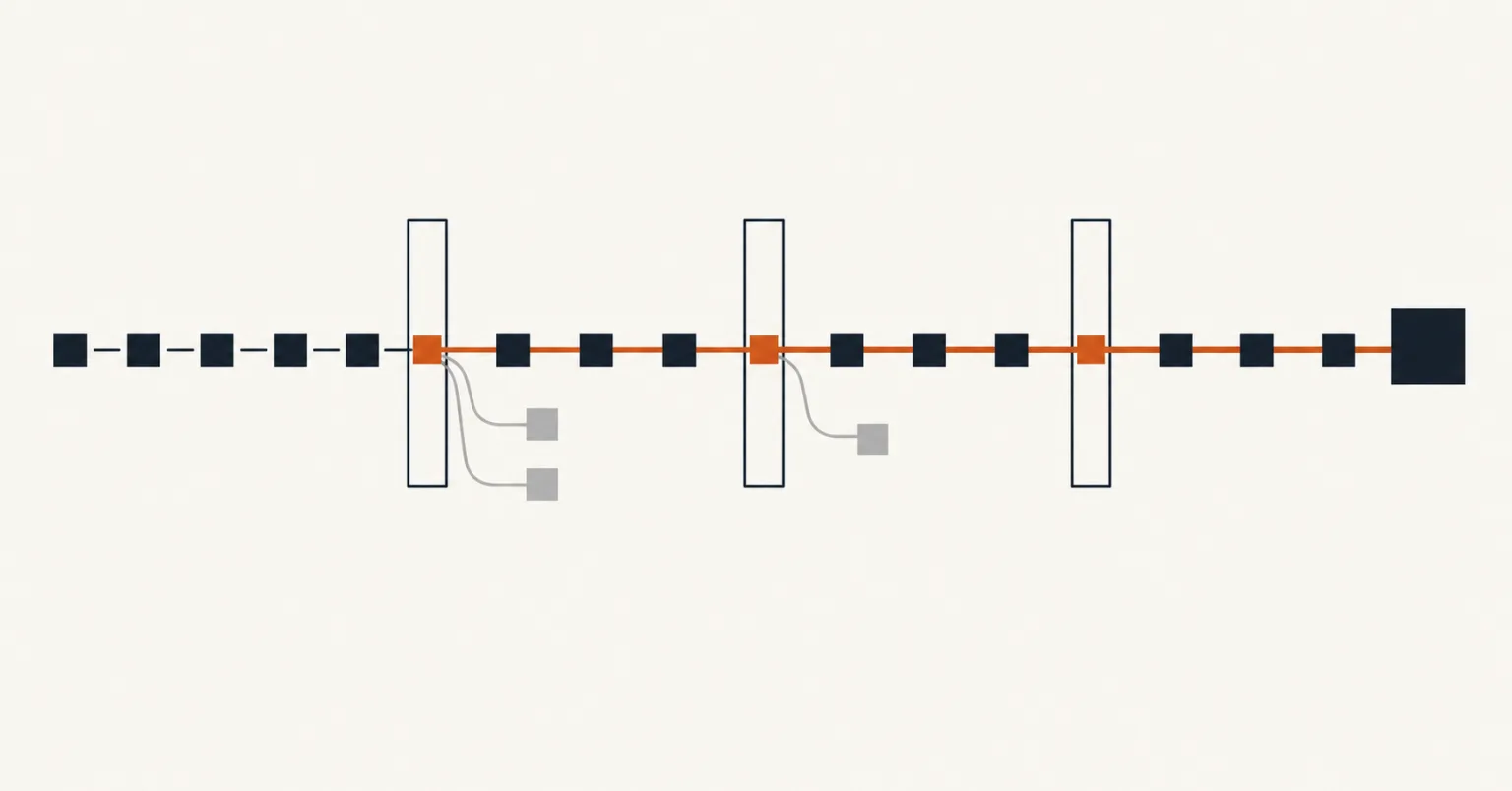
A lower price on the model bill is easy to recognize. A lower cost for finished work takes more effort to establish. Follow a task past the generated answer: somebody may still need to check it, repair it, or start again. That is where a promising inference price has to earn its place in the business case.
In its October 19 M3.1 Flash announcement, MiniMax describes improvements in agent work, coding, computer use, and inference efficiency. The company quotes prices of $0.15 per million input tokens and $0.60 per million output tokens, with a lower cached-input rate, and says model weights will follow later. Its benchmark and relative-cost statements are vendor claims. They identify a candidate for evaluation rather than proving savings in a different company’s workflow.
What are you actually buying when you make that comparison? Define a verified outcome, then count the work needed to reach it under the real permissions, tools, and review conditions. The price sheet gives you an input to that calculation. The person accepting the completed task gives you the point at which to stop counting.
Define completion before counting tokens
For a coding task, completion might require a change that passes the relevant checks and is accepted by the reviewer. For a support task, it might require a correctly routed case with the information needed by the receiving team. The important point is to state that condition before testing the model.
If the acceptance condition changes between candidates, a cost comparison becomes difficult to interpret. A fast model that returns a plausible draft and a slower model that finishes the required verification are doing different amounts of work. Record the outcome, the checks performed, and the unresolved issues alongside the usage numbers.
Include unsuccessful attempts in the denominator of the business decision. Retrying until a task passes can conceal a weak first-attempt result if the report presents only the successful trajectory. The team buying the capability pays for the whole process, including abandoned attempts and the work needed to diagnose them.
Hold the workflow steady
Keep the workbench still while changing the model. Use the same tasks, tool interfaces, context, and acceptance criteria so the difference has somewhere specific to come from. A candidate may need a different prompt or configuration to work well. Record that arrangement separately. You can then ask whether the improvement came from the model, the setup, or the combination you would actually operate.
Use tasks drawn from the application’s ordinary workload and its expensive edge cases. A model that handles routine requests cheaply may still impose substantial review cost on the cases that matter most. Report those groups separately so a favorable average does not erase a difficult class of work.
The resulting decision need not name one model for everything. It may support a narrower routing choice, a supervised pilot, or no immediate change. The objective is to identify where the candidate’s behavior fits the work, not to reproduce a vendor’s aggregate ranking on an unrelated task set.
Keep costs outside the model in view
Token charges are visible because providers meter them. Review, integration, and recovery often need deliberate measurement. A comparison should therefore state which costs it includes and which remain estimates. Otherwise a precise token total can give a rough business case an undeserved appearance of certainty.
Sit beside the review step in the calculation. How long does it take to establish that the answer is correct? Reading a polished response and checking its evidence are different pieces of work. If the cheaper candidate makes verification harder, count that time. When a failure sends an engineer through a long agent trace, keep the engineer’s work attached to the task that caused it.
Also separate a successful pilot from an operating commitment. The announcement’s availability, commercial terms, and future weight-release plans describe different deployment choices. Evaluate the choice actually available for the pilot, and revisit the decision if the deployment model changes.
Make the result repeatable
Preserve the task set, expected outcomes, model identifier, configuration, and scoring procedure. That record lets the team compare a later version without starting the argument over what the earlier result meant. Where the provider does not expose a stable version, record the test date and the limitation explicitly.
Look for disagreement between quality and cost measures rather than forcing one headline number. A candidate may reduce usage charges while increasing retries, or improve first-attempt results while taking longer. Those tradeoffs can be acceptable, but the application owner needs to choose them deliberately.
Write the assumptions beside the result. If review time is converted into money, show the rate and explain whether the time is actually available for other work. If a task’s failure cost is unknown, show how the conclusion changes across plausible values. A model choice that depends on one optimistic assumption deserves a narrower pilot than a choice that remains useful under several reasonable operating conditions.
Choose a workflow with a clear completion condition and somebody already responsible for accepting the result. Give the current configuration and the new candidate the same examples. Count the accepted outcomes, the failed attempts, and the work that connects them. Then return to the lower price on the announcement page. You can explain whether it changes the cost of a task the organization is willing to call complete.