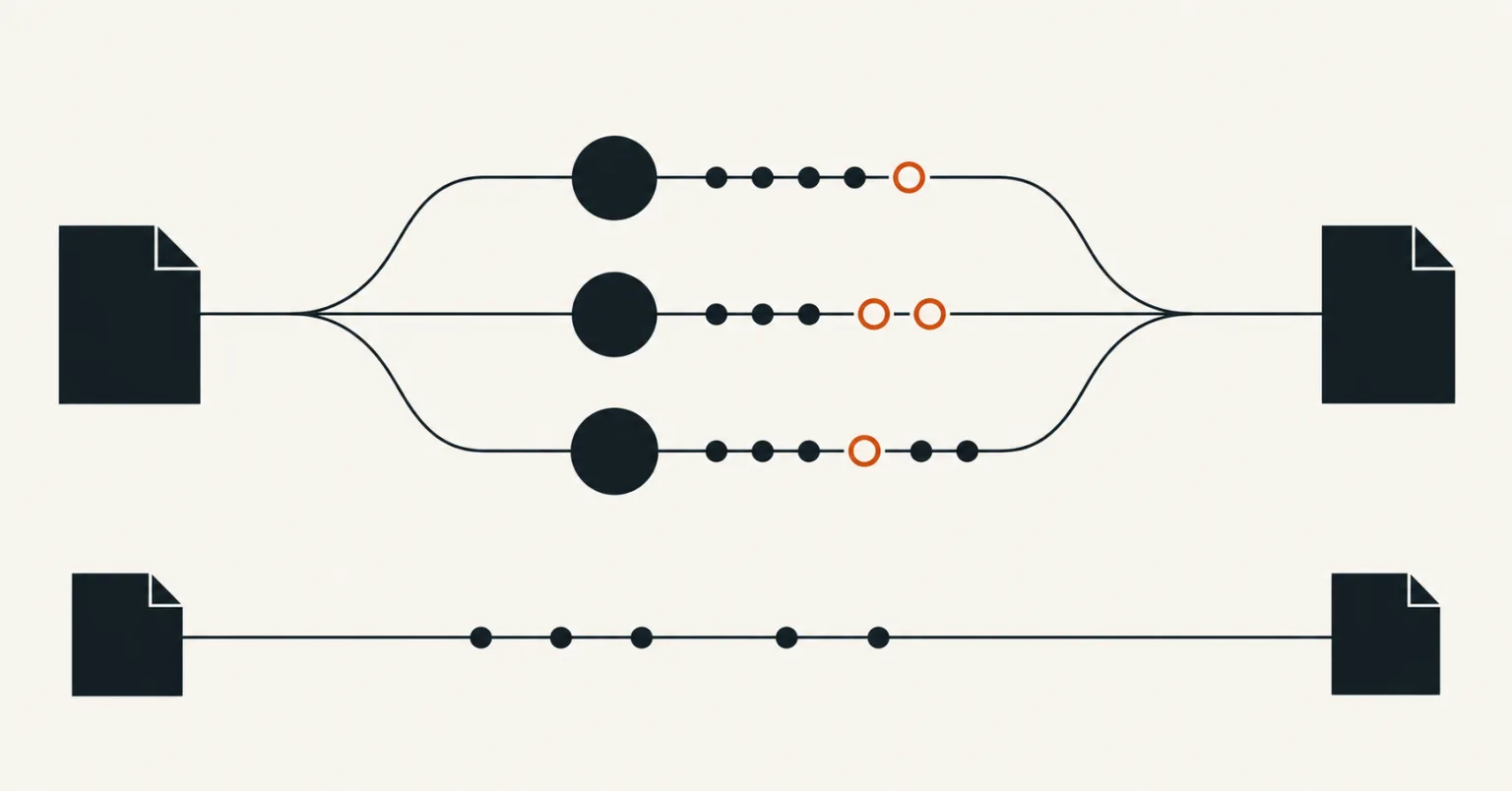
A review that puts more warnings on the desk also puts more decisions there. Somebody must work out which warnings identify a defect and which create another investigation. Dividing the review among agents may help cover the requirements. To judge the result, follow their findings to the person who has to use them.
A controlled comparison on credit-assessment memos tests a single agent against a three-agent division of the same requirements. On synthetic memos with known labels, the team catches more of some defects but raises more false alarms and uses roughly 2.2–2.4 times the tokens. The results vary with the model and instructions. They do not establish that every multi-agent design is ineffective, or that the study reproduces an institution’s actual review process.
Treat the review architecture as a way of organizing work. Follow a finding from detection through investigation, disagreement, and resolution. That path lets the team compare what the agents contribute with the work their findings create for the people responsible for the decision. The final list is the beginning of that comparison.
Define a finding that somebody can use
Try handing a finding to a reviewer who did not watch the agents work. Can that person identify the requirement, inspect the evidence, understand the alleged defect, and see what would resolve it? Those are useful contents for the handoff. Without them, another warning can become another search for what the warning was trying to say.
For an evaluation, establish a reviewed reference for each requirement and record where judgment remains uncertain. Separate a clear defect from a reasonable request for clarification. If the task itself has ambiguous labels, the system’s disagreement with a reference may need expert adjudication before it becomes a performance claim.
Keep the scope narrow enough to understand. The paper evaluates a particular document-review task, not the entire financial decision behind it. An enterprise pilot should be equally clear about which step the agents are supporting and which decisions remain with the authorized reviewer.
Count the cost of false alarms
A system that identifies more potential defects can appear more thorough. The value depends on how many of those findings are valid and how much work the others require. Every false alarm has a path through the review process, even if the model call that generated it was inexpensive.
Count the work between the warning and its disposition. Someone has to investigate it, reconcile conflicting accounts, and close it. If agents raise overlapping versions of the same concern, include the time spent putting those versions together. A long list can look comprehensive while leaving the reviewer to supply the structure that would make it useful.
Also examine what a reviewer does after repeated weak findings. The pilot should observe how people use the output, including whether they can distinguish urgent issues from routine noise. That is a question to measure locally rather than an assumed consequence of a benchmark score.
Keep the comparison fair
Use the same documents, requirements, and available evidence for the baseline and proposed team. Record differences in prompts, roles, shared context, aggregation, and stopping rules. A team with a broader context or a later verification stage is a different configuration from a simple split of one call.
Include a straightforward repeated-call baseline where it fits the task. The paper itself examines alternatives to dividing requirements among specialists. Such comparisons can help establish whether an improvement comes from more sampling, a clearer instruction, or the organizational structure of the agent team.
Measure total usage and elapsed time for the complete review, including the aggregation step. A parallel architecture may change latency differently from cost, and retries can alter both. The application owner needs those quantities separately to decide which tradeoffs are acceptable.
Preserve shared context carefully
Splitting requirements can remove information that helps a reviewer interpret a finding. The research includes experiments on showing agents requirements assigned elsewhere in the team. That makes context distribution an explicit variable worth evaluating in a local design.
An enterprise team should identify which facts every reviewer needs and which can remain specialized. The aggregation step should preserve the evidence behind disagreements instead of forcing an unsupported consensus. If two agents interpret a requirement differently, that difference may be useful information for a human to resolve.
Do not treat a majority as an independent reference by default. Agents using the same model or similar prompts may make related mistakes. Agreement can be an observation in the evaluation, but it needs comparison with evidence the organization is prepared to trust.
Weight findings by the work they cause and the decision they affect. Ten repeated comments about one minor issue should not count as ten independent improvements. Deduplicate accepted findings and record which ones changed the document or the reviewer’s conclusion before comparing architectures.
Choose the simplest useful architecture
Begin with a bounded document set and the review process already in use. Compare accepted findings, missed defects, false alarms, human effort, latency, and model usage. Preserve representative disagreements so a later change can be evaluated against the same problems.
The comparison may favor a team, a single reviewer with a better prompt, or a selective second pass. Let the measured work decide. Then return to the desk where the findings arrive. Can the accountable person use them to reach a better-supported decision, with a clear understanding of what was checked? That is the result the review architecture needs to deliver.