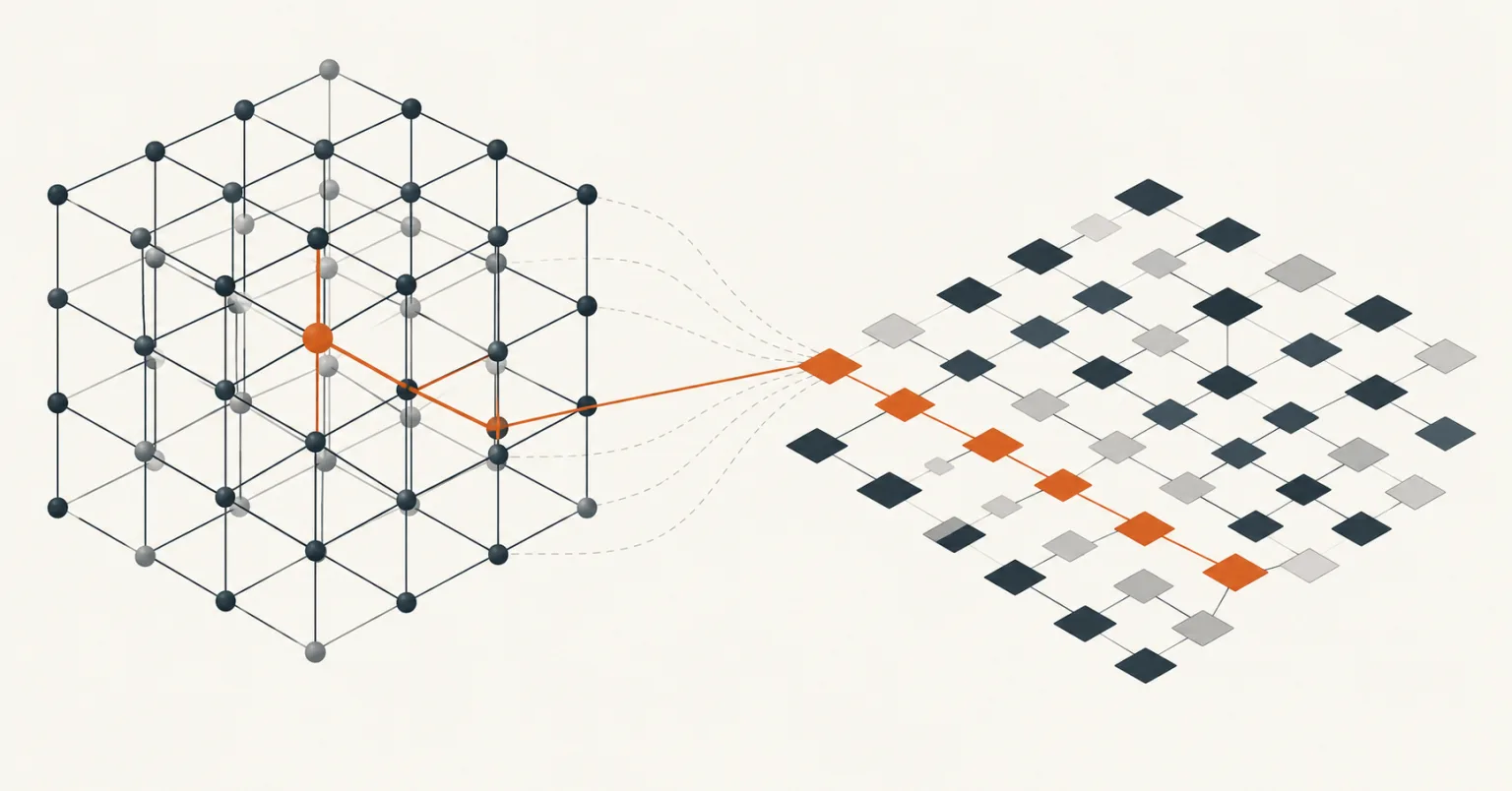
Give a model a list of parts and it may still miss how the parts fit together. When its answer disappoints, the tempting response is to buy a bigger model. Before doing that, ask a smaller question: did we give it the relationship it needed to see? Materials research offers a useful way to examine that question.
MIT reports a multimodal approach to crystalline materials that connects atomic structures with natural-language descriptions. The researchers combine information about geometry with accounts of properties, processing, and potential uses. MIT says their structure-aware approach outperformed a text-only comparison and identified promising candidates for a battery-electrolyte query. Those are research findings, not a claim that a production materials-discovery service is ready to replace laboratory work.
You can ask the same question outside a materials laboratory. Which distinctions can the system make from the shape of the input it receives?
The information lost in a paragraph
A paragraph describing a material can name its ingredients without fully conveying their arrangement. In a business setting, an analogous loss occurs when an equipment diagram becomes a list of components, or a process map becomes disconnected descriptions of individual steps. The resulting text may remain readable while obscuring the relationships that make the record useful.
Someone has to decide what survives the conversion. Put the original record beside the version the model receives and ask a specialist what has gone missing. Does adjacency matter? Does the order of the steps change the result? Geometry, dependencies, and constraints carry different kinds of meaning. Keeping every word is a useful check, but you also need to know whether the conversion kept the evidence those words were meant to describe.
This does not establish that every enterprise application needs a new multimodal architecture. It establishes a sensible question for a pilot: what does the model need to perceive that the current input never actually gives it?
Synthetic descriptions need a reference
The research also makes generated descriptions interesting as a bridge between representations. A description can help connect specialized data to the language interface people already know how to use. But a generated description should remain attached to its underlying record. Otherwise the organization risks substituting an attractive account of an object for the object itself.
For a practical evaluation, keep the original structured input, its generated description, and the output decision together. Have a domain specialist identify a small set of relationships that the description must preserve. Then test whether another reviewer can recover those relationships from the description without guessing. The result is a check on information preservation before it becomes a debate about model intelligence.
Treat omissions separately from factual errors. A description can contain no obviously false sentence and still leave out the one constraint that changes the answer. That distinction matters when the downstream task selects a candidate, recommends an action, or prioritizes an expensive experiment.
Compare representations before comparing vendors
Try that comparison before changing vendors. Give the system the same task and evaluation records, then change how it receives the evidence. One version uses the current text-only workflow. Another preserves the relationships the specialists say are essential. Ask an experienced reviewer what a useful answer would have to notice. You now have a way to investigate the missing information while keeping the rest of the problem still.
The test should ask about decisions, not just fluent explanations. Did the system identify the right constraint? Did it exclude an unsuitable candidate for the right reason? Could the reviewer locate the evidence behind the recommendation? A description that sounds technically accomplished is a weak substitute for these checks.
Also keep a category for unfamiliar inputs. A system can perform well on the structures represented heavily in its development data and struggle elsewhere. The operational question is whether it recognizes when the available evidence is insufficient, and whether that uncertainty reaches the person responsible for the next step.
Keep the experiment connected to the work
For industrial research teams, a model-generated shortlist should enter an existing review process with its provenance intact. The original inputs, selection criteria, and rejection reasons are useful even when a suggested candidate turns out to be unsuitable. They let the team distinguish an interesting scientific lead from a formatting or retrieval mistake.
This is also where a business case becomes more concrete. A pilot might aim to improve the quality of candidates entering an experiment queue, reduce avoidable review, or expose neglected classes of inputs. Those are hypotheses to measure locally. The MIT report does not provide a shortcut to a financial return for a different organization.
When a candidate fails, keep enough of the trail to explain why. Was the input inaccurate? Was a relationship lost? Did the model make a mistake, or did physical testing introduce a constraint the earlier record could not establish? Each answer points toward different work. More training examples cannot repair a missing measurement. A stronger language model cannot establish a physical property that has never been tested.
Choose a recurring decision where an expert can point to something the current text hides. Put that relationship back into the input, compare the decisions, and keep the result. Then return to the buying question. If the model was missing the arrangement of the parts, a better view of those parts may do more for the work than a larger model looking at the same incomplete list.